
6.3 min read
Paper vs. other baking moulds: why panettone needs 1 paper mould
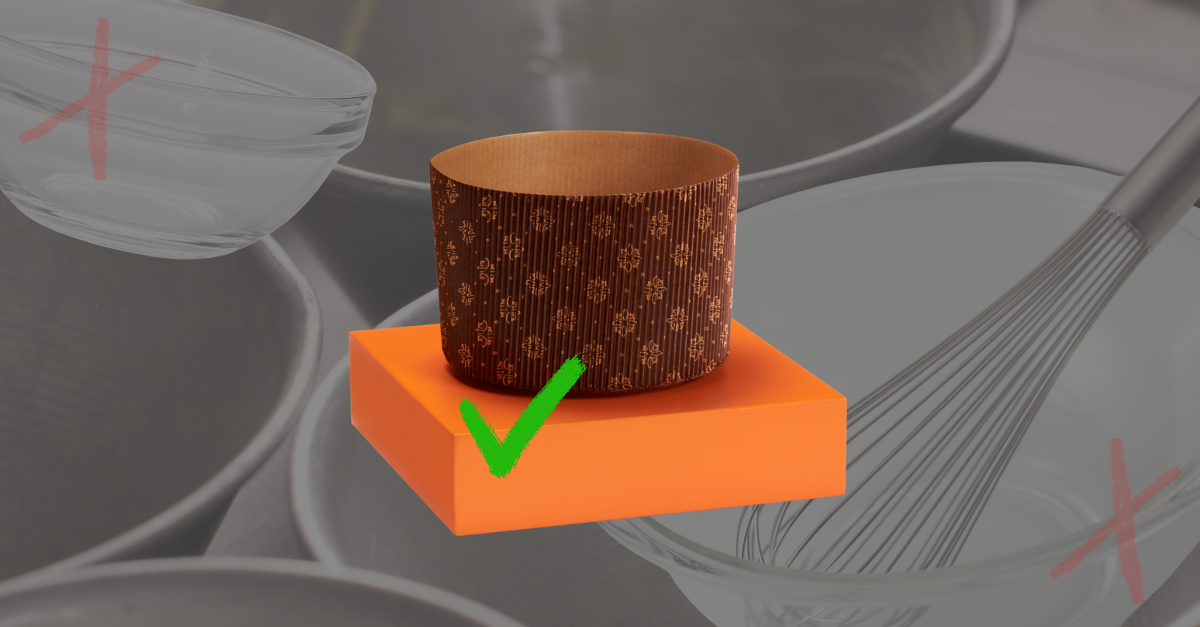
Panettone is one of the few baked goods where the baking mould has as much impact on the final result as the recipe itself. A rich dough made with eggs and butter, subjected to long fermentation times, needs to rise vertically, retain its structure throughout baking, and cool upside down without collapsing. This is why the paper mould is not simply a container: it is an integral part of the production process.
Since 1939, we have been designing and manufacturing paper baking moulds in Turin, Italy. With more than eighty years of expertise, we have learned that the quality of panettone depends not only on the ingredients and process, but also on the mould that supports the product from proofing through to packaging.
Why metal and glass are not the same
Panettone dough behaves very differently from cake batter or standard bread dough. During proofing, it develops its structure by rising along the sides of the mould, and the surface it comes into contact with directly influences the way it expands.
The smooth surfaces of metal and glass provide very little grip, encouraging the dough to spread outwards rather than rise upwards. Paper, by contrast, has a slightly textured surface that supports the dough as it rises, helping to create panettone’s characteristic domed shape.
The different materials also behave differently during baking. Metal transfers heat very quickly and tends to retain more steam against the sides of the mould. Paper, on the other hand, allows moisture to escape more evenly, promoting uniform baking, a well-developed crust, and the soft, long, shreddable crumb that defines a high-quality panettone.
A mould designed to support dough development
The Panettone Alto range has been specifically developed to support the vertical growth of the dough. Sizes range from small 60–70 mm panettoni to large diameters designed for industrial production, while maintaining carefully studied proportions to encourage the formation of the characteristic dome.
When filled between half and two-thirds of its volume, the mould provides the dough with the necessary space to rise above the edge during the final proofing stage.
The paper surface supports the upward expansion of the dough, while the mould’s rigidity maintains the cylindrical shape throughout baking. Our automated production lines ensure tight dimensional tolerances and consistent geometry, essential features both for finished product uniformity and for integration into automated production processes.
Upside-down cooling
Once removed from the oven, panettone must be cooled upside down to prevent the weight of the still-warm crumb from causing the dome to collapse.
For this reason, two skewers are inserted through the mould, approximately one centimetre above the base, and the product remains suspended for at least two hours, often overnight in sourdough-based production processes.
The mould must therefore support the weight of the panettone throughout this stage without deforming or failing. This is a function that paper moulds have always been designed to perform, while materials such as glass or metal cannot offer the same level of practicality and process efficiency.
How paper performs in the oven
Our moulds withstand temperatures of up to 220°C and can also be used for freezing down to -18°C. Since panettone is normally baked at temperatures between 160°C and 175°C, they operate with a wide safety margin and are certified for direct food contact.

Min: -18 °C

Max: 220 °C
During baking, paper helps distribute heat more gradually compared to metal and allows controlled steam release. This balance promotes an even crust colour and the characteristic soft texture of the crumb, while maintaining the stability and integrity of the mould throughout the baking process.
How to choose a panettone mould
The first aspect to check is certification for food contact. The paper and grease-resistant treatments used must be suitable for baking temperatures and compliant with current regulations. All our baking moulds and baking cups are certified for direct food contact and are made with FSC® certified paper.
A second key element concerns PFAS. The European Packaging Regulation (PPWR – EU Regulation 2025/40) prohibits their use in food packaging from 12 August 2026. Our range of baking moulds has been completely PFAS-free for a lot of time, well ahead of the regulation’s entry into force. For those looking for a compostable solution, our Panettone Alto and Panettone Basso moulds are certified OK Compost Industrial by TÜV Austria.
Finally, it is important to distinguish between a mould specifically designed for panettone and a container adapted for other types of dough. Paper thickness, rigidity, dimensional accuracy, and manufacturing quality directly affect proofing consistency, baking performance, and product stability through to the packaging stage.
Since 1939, we have been operating from Turin, Italy, with production facilities in Italy, Brazil, Canada, India, and Tunisia. Our catalogue includes more than 800 items, including shapes, papers, and colours, with fully customisable solutions available. This production capability allows us to support food industries, artisan bakeries, and retail brands with consistent quality standards and solutions developed around each customer’s specific production requirements.
The mould is part of the recipe
In panettone production, the mould does not simply contain the dough. It supports its growth, maintains the structure during baking, enables upside-down cooling, and contributes to the quality of the finished product.
For traditional recipes, the Tall profile is the most widely used choice. However, regardless of the size or format, it is essential to select a mould specifically designed for this type of dough, certified for food contact, PFAS-free, and engineered to deliver consistent results throughout every stage of the production process.

 Ecopack Italy
 Ecopack Brazil
 Ecopack Canada
 Ecopack India
 Ecopack Tunisia


